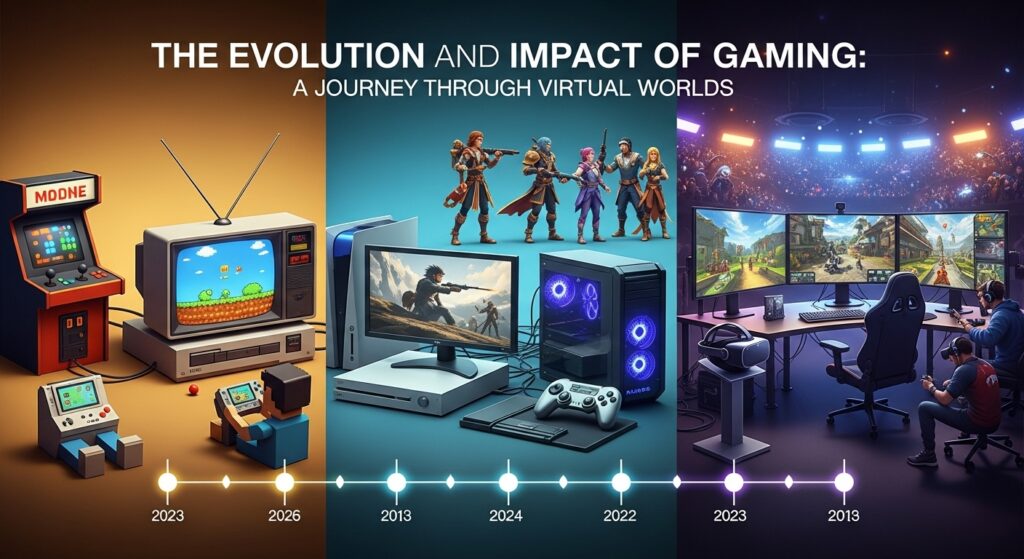
Gaming is more than just a pastime — it’s a culture, a multi-billion-dollar industry, and a global phenomenon that connects people from every corner of the planet. What began as a few blinking pixels on a screen has transformed into vast digital universes filled with cinematic stories, competitive arenas, and immersive virtual realities. Over the decades, gaming has evolved alongside technology, redefining how we play, learn, and even communicate.
This blog dives deep into the journey of gaming — from its humble beginnings to its high-tech future — exploring how it became one of the most influential forces in entertainment and society today.
The Origins of Gaming
The story of gaming begins in the mid-20th century. In the 1950s and 1960s, scientists and computer enthusiasts started experimenting with interactive programs. The earliest known example of a video game is often considered to be “Tennis for Two,” created in 1958 by physicist William Higinbotham. It was a simple tennis simulation played on an oscilloscope screen, but it set the foundation for what was to come.
Then, in the early 1970s, the arcade era dawned. “Pong,” released by Atari in 1972, became the first commercially successful arcade video game. Its success was immediate and widespread, turning arcades into popular hangouts for young people. Soon after, other titles like “Space Invaders,” “Asteroids,” and “Pac-Man” took the world by storm, introducing millions to the excitement of digital entertainment.
These early games were simple, but they captured the essence of competition and fun. The graphics were minimal, but the imagination they sparked was infinite. Players didn’t just see dots and lines; they saw spaceships, heroes, and challenges to overcome.
The Birth of Home Consoles
The arcade boom paved the way for gaming’s next big leap: home consoles. In 1977, the Atari 2600 brought video gaming into living rooms across the world. For the first time, families could enjoy gaming at home, without the need for coins or crowded arcades.
Throughout the 1980s, companies like Nintendo and Sega entered the scene, sparking what many consider the “golden age” of gaming. Nintendo’s Entertainment System (NES), released in 1985, revolutionized the industry with games like Super Mario Bros., The Legend of Zelda, and Metroid. These titles weren’t just games — they were experiences that built worlds and characters players would remember for decades.
Sega countered with its own consoles, including the Sega Genesis, which hosted legendary franchises like Sonic the Hedgehog. The rivalry between Nintendo and Sega defined an entire generation, pushing both companies to innovate faster and tell richer stories.
The Rise of 3D Gaming
As technology advanced, so did the ambition of game developers. The 1990s introduced players to a new dimension — literally. The leap from 2D to 3D graphics completely transformed the way games looked and felt.
With consoles like the Sony PlayStation and Nintendo 64, players could now explore vast, three-dimensional worlds. Games like Super Mario 64 and The Legend of Zelda: Ocarina of Time redefined what was possible, giving players freedom and immersion like never before. The PlayStation, in particular, became a global phenomenon with titles such as Final Fantasy VII, Metal Gear Solid, and Resident Evil.
PC gaming also saw massive growth during this era. With the rise of personal computers, players could experience games that were larger, more complex, and graphically superior. Classics like Doom, Quake, and Half-Life shaped the first-person shooter genre and paved the way for online multiplayer gaming.
Online Gaming and the Age of Connectivity
The late 1990s and early 2000s marked another revolutionary period — the birth of online gaming. With the rise of the internet, games were no longer limited to single-player adventures or local multiplayer modes. Players could now connect with others across the globe in real-time.
Early examples like EverQuest and Runescape introduced the concept of massive multiplayer online games, or MMOs. These digital worlds allowed thousands of players to interact, cooperate, and compete in shared spaces. Then came World of Warcraft in 2004, which became a cultural landmark, attracting millions of subscribers and defining what an online game could be.
Meanwhile, first-person shooters like Counter-Strike and Halo became staples of online competition, giving birth to what we now know as esports. Players could now test their skills against others in ranked matches, tournaments, and leagues — transforming gaming into a legitimate sport.
The Emergence of Esports
Esports — or competitive gaming — is one of the most remarkable developments in modern gaming culture. What started as small LAN parties and community tournaments has grown into a billion-dollar global industry. Today, professional gamers compete in massive arenas filled with fans, with millions more watching online.
Games like League of Legends, Dota 2, Overwatch, and Counter-Strike: Global Offensive have become cornerstones of the esports scene. These games require intense skill, strategy, teamwork, and split-second decision-making — every bit as demanding as traditional sports.
Esports has also created opportunities for players to build careers as streamers, commentators, coaches, and content creators. Platforms like Twitch and YouTube Gaming have further expanded the scene, allowing fans to follow their favorite players and teams 24/7.
What was once seen as a hobby for “nerds” is now a mainstream spectacle. Stadiums fill with cheering crowds, sponsors pour in millions, and players become celebrities.
Mobile Gaming and the Rise of Accessibility
The 2010s saw another huge shift in gaming: the explosion of mobile gaming. With smartphones becoming ubiquitous, gaming suddenly became accessible to billions of people. Titles like Angry Birds, Clash of Clans, and Candy Crush Saga turned casual gaming into a global obsession.
Mobile gaming didn’t just make gaming easier to access — it changed how we think about it. Players no longer needed expensive consoles or PCs to enjoy quality games. Anyone with a phone could play, anywhere, anytime.
In recent years, mobile gaming has grown far beyond casual titles. Complex and competitive games like PUBG Mobile, Call of Duty Mobile, and Genshin Impact have pushed the limits of what mobile devices can do. Some mobile esports tournaments now rival traditional console and PC events in both prize money and popularity.
The Art of Storytelling in Games
One of the most beautiful aspects of gaming’s evolution is how it has embraced storytelling. Early games relied on simple narratives — rescue the princess, save the world, defeat the villain. But today, games can deliver emotional, cinematic stories rivaling those of Hollywood films.
Games like The Last of Us, Red Dead Redemption 2, and God of War showcase deep, human stories filled with moral complexity and character development. Players don’t just watch these stories unfold — they live them. Their choices shape the narrative, giving them a sense of agency that no other medium can match.
Story-driven games have proven that gaming is not just about reflexes and competition. It’s an art form capable of evoking emotion, reflection, and even empathy. Developers use music, dialogue, visuals, and gameplay mechanics to create powerful emotional experiences that linger long after the credits roll.
The Role of Technology: Graphics, AI, and Virtual Reality
Gaming has always been intertwined with technological advancement. Each new generation of consoles and PCs brings more power, enabling developers to create more realistic worlds.
Modern games feature photorealistic graphics, powered by advanced engines and real-time ray tracing. Artificial intelligence has also become a major factor, making enemies smarter, allies more believable, and worlds more alive.
Then there’s virtual reality (VR) — perhaps the most transformative innovation yet. With VR headsets like the Oculus Quest and PlayStation VR, players can now step directly into the game world. They can look around, move their hands, and feel like they’re truly inside another universe.
Augmented reality (AR) has also made its mark. Games like Pokémon GO have blended the real world with the digital one, encouraging players to explore their surroundings while catching virtual creatures.
The fusion of technology and creativity continues to push gaming into new frontiers, blurring the line between the real and the virtual.
The Social Side of Gaming
Gaming has always been social, but never as much as it is today. Online multiplayer games, voice chat, streaming platforms, and social media have turned gaming into a shared experience.
People don’t just play games anymore — they build communities around them. Whether it’s forming guilds in an MMO, joining Discord servers, or streaming gameplay for thousands of viewers, gaming has become a way to connect.
For many, games are a place to meet friends, express themselves, and find belonging. Titles like Minecraft and Roblox allow players to create and share their own worlds, fostering creativity and collaboration.
Even during difficult times, such as global lockdowns, gaming provided a vital form of connection. Friends and families played together across distances, proving that gaming is not just entertainment — it’s a form of social interaction.
The Business of Gaming
Gaming is now one of the most profitable industries on the planet. It surpasses movies and music combined in annual revenue. From indie developers to massive corporations, the gaming market has expanded to include a wide variety of products, services, and monetization models.
Subscription services like Xbox Game Pass and PlayStation Plus have changed how players access games, offering hundreds of titles for a monthly fee. Free-to-play models, supported by in-game purchases, have also become dominant. While controversial at times, they’ve made gaming more accessible than ever.
Esports, streaming, and merchandise add even more layers to the business side. Gaming conventions, tournaments, and influencer marketing have turned gaming into a cultural and economic powerhouse.
The Cultural Impact of Gaming
Gaming has influenced culture in ways few could have predicted. Characters like Mario, Sonic, and Lara Croft are as recognizable as movie stars. Game soundtracks have won awards, and gaming references appear in films, fashion, and art.
Gaming also shapes how we think and learn. Many educators use games as tools to teach problem-solving, teamwork, and creativity. Simulation games like The Sims and Cities: Skylines teach resource management, while puzzle games enhance cognitive skills.
Moreover, gaming has become a platform for storytelling, self-expression, and even activism. Games like Life is Strange and Undertale explore complex social themes, while others promote empathy by placing players in unfamiliar perspectives.
The Future of Gaming
What lies ahead for gaming? The possibilities are nearly limitless. Cloud gaming is already reshaping how we play by allowing players to stream games directly to their devices, removing the need for powerful hardware.
Artificial intelligence will continue to make games smarter and more adaptive. Virtual and augmented reality will grow more immersive, creating experiences that blur the boundaries between physical and digital.
We might also see more focus on inclusivity, accessibility, and sustainability. Developers are finding ways to make games playable for everyone, regardless of physical ability or experience level. Gaming’s global reach will continue to expand, connecting people from different cultures and backgrounds like never before.
Conclusion: Gaming as the Ultimate Human Experience
From the first pixelated screens to hyper-realistic virtual worlds, gaming has come a long way. It has evolved from a niche hobby into one of the defining cultural forces of our time.
Gaming is more than entertainment — it’s creativity, connection, and innovation. It’s a medium where art, technology, and human emotion collide. It’s where people can become heroes, explorers, creators, and dreamers.
As we look toward the future, one thing is certain: gaming will continue to grow, evolve, and inspire. No matter the platform or technology, the core of gaming will always remain the same — the joy of play, the thrill of challenge, and the magic of imagination.